
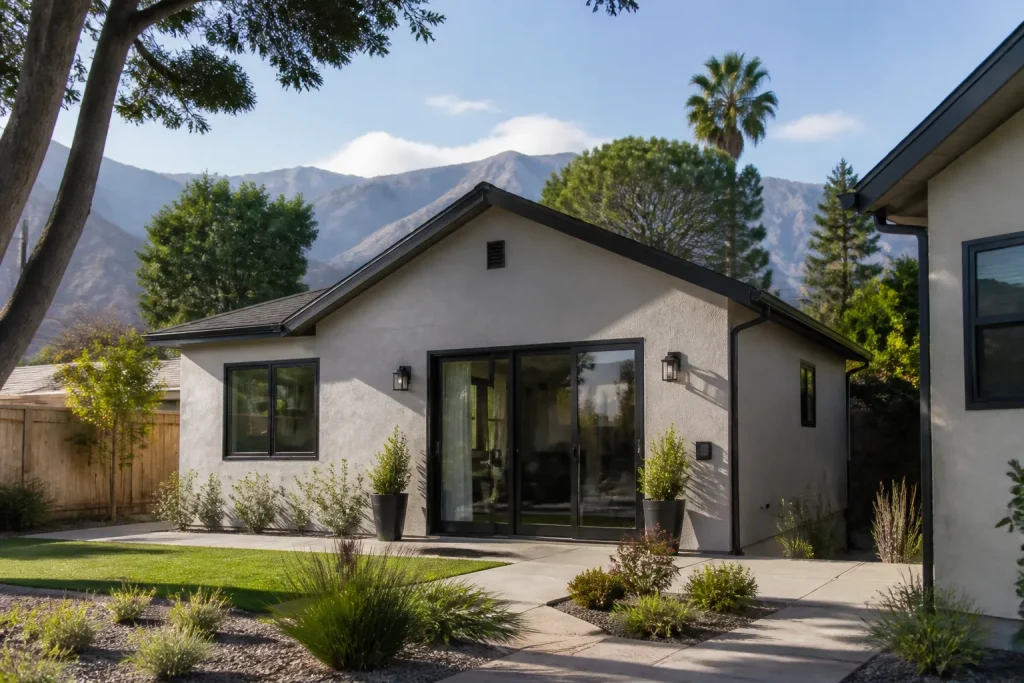
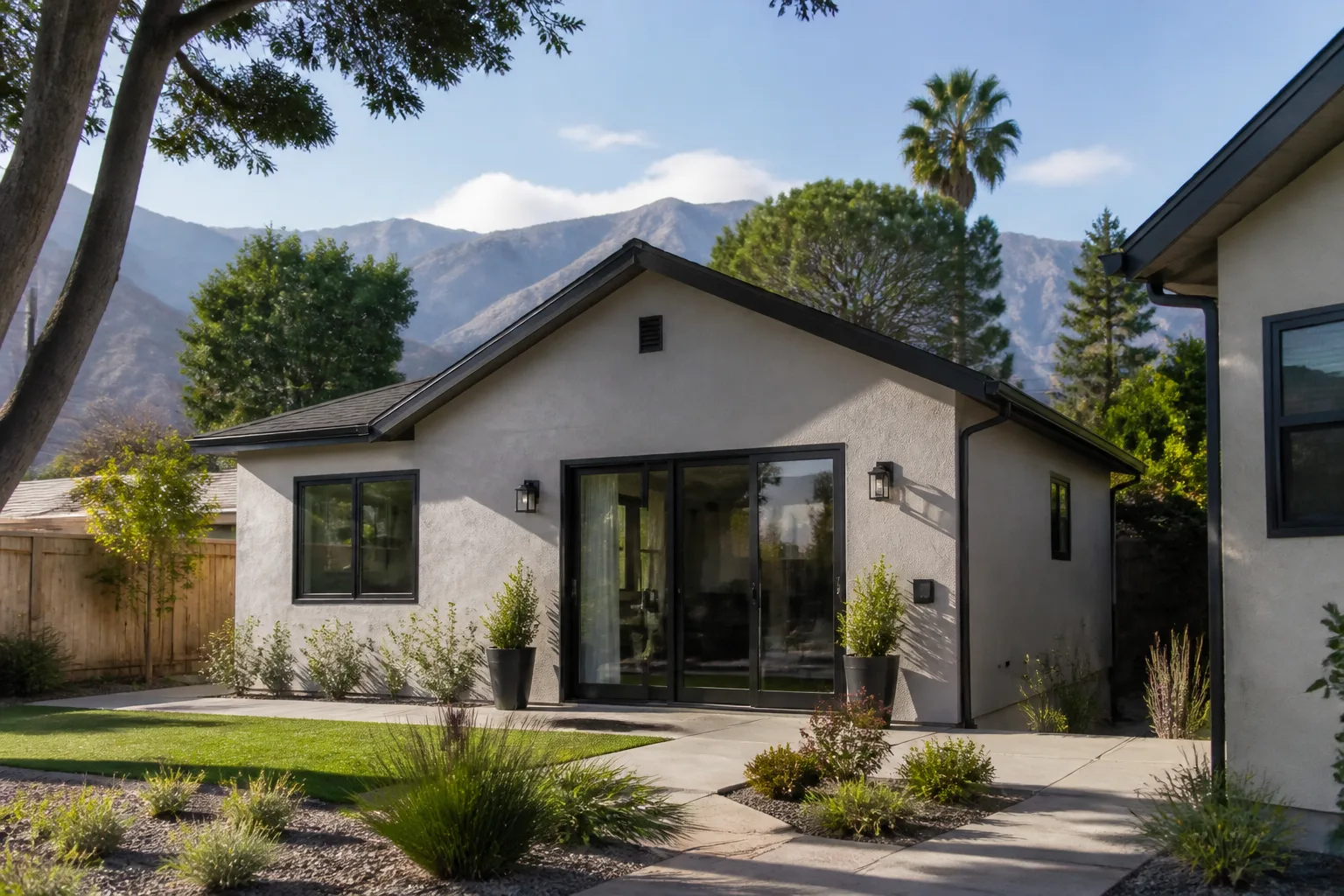
ADU Builders Cost Guide: What Highland Homeowners Pay in 2026
Highland homeowners building an ADU in 2026 should budget between $210,000 and $385,000 for a turnkey detached unit, with most projects landing near $275,000 for an 800 – 1,000 square foot one-bedroom. That number includes everything from San Bernardino County permits to final paint, but excludes the $80,000-plus swings caused by site conditions like slope, electrical panel capacity, and sewer versus septic connections. The $150,000 to $300,000 range you’ll find on most cost guides is technically true the same way “most cars cost between $20,000 and $80,000” is true. It’s not wrong. It’s just not useful for writing a check.
If you’d rather skip the deep dive and get a real number for your specific lot in Highland, call (855) 676-6807 for a free estimate. But if you’re in research mode, here’s what actually moves the number in this city.
What Highland ADUs Actually Cost in 2026: A Line-Item Breakdown
Every ADU budget in Highland breaks into five buckets, and knowing these numbers before you talk to builders is the difference between a quote that holds up and a quote that balloons three months in. Here’s what we’re seeing across San Bernardino County in 2026:
- Site preparation and pads: $25,000 – $55,000. This includes demolition (if any), grading, foundation, and drainage. Highland has a mix of older lots in the East Highland area with established landscaping and newer parcels up near the foothills with more grade change. If your yard slopes more than 18 inches across the ADU footprint, expect the higher end.
- Construction shell: $120,000 – $210,000. This is framing, sheathing, roofing, windows, exterior siding, and insulation. It’s the biggest line item, and it’s where build method (prefab, modular, stick-built) causes the widest spread.
- Mechanical, electrical, plumbing (MEP): $35,000 – $65,000. This includes panel upgrades, trenching for utilities, water heater, and HVAC. A panel upgrade alone runs $3,500 – $6,500 in Highland, and if your existing 100-amp panel is maxed out, that number is non-negotiable.
- Interior finishes: $30,000 – $55,000. Flooring, drywall, paint, cabinets, countertops, bathroom fixtures, and kitchen appliances. This is where we see Highland homeowners make up or blow budgets. A mid-grade kitchen in an ADU runs $15,000 – $25,000; the bathroom runs $10,000 – $18,000. You can spend less or a lot more, but those are working numbers for a unit that rents for top of market.
- San Bernardino County fees and permits: $18,000 – $38,000. This bucket gets left out of builder quotes constantly, often intentionally, because it makes the headline number look lean. More detail on this below.
That totals $228,000 to $423,000 at the extremes, but the median Highland project we see is $260,000 – $290,000 for a well-finished one-bedroom attached or detached ADU. For a more detailed look at how these numbers apply to Highland specifically, we’ve broken down local cost drivers on our main ADU page.
The Fees Most Builders Leave Out of Their Quotes
In San Bernardino County, the permit path for an ADU is not a single fee. It’s a stack. And the stack is taller than most homeowners expect, because statewide ADU legislation streamlined some approvals but did not eliminate local charges. Here’s what Highland homeowners are actually paying in 2026:
| Fee Category | Typical Range in Highland |
|---|---|
| San Bernardino County building permit | $6,500 – $11,000 (based on sq ft valuation) |
| Planning and zoning review | $1,500 – $3,000 |
| School impact fees (SB 9 exemption may apply) | $0 – $4,000 (waived for ADUs under 750 sq ft) |
| Utility connection fees (water, sewer if applicable) | $4,000 – $9,500 |
| Fire sprinkler requirement (if triggered) | $3,500 – $7,000 |
| Grading or encroachment permits (site dependent) | $0 – $5,000 |
Before you sign any builder agreement, ask for a written fee schedule that separates San Bernardino County charges from the builder’s own pricing. If the quote says “permits included” without a number next to it, ask for the actual line item. A real builder can tell you exactly what the county charged them on their last three Highland projects. A builder who hedges on this question is pricing a range, not a project.
The Three Site Conditions That Move the Number by $80,000
Your lot determines your ADU budget more than your floor plan does. In Highland, we see three site variables cause the most dramatic cost swings, and none of them show up in online cost calculators.
1. Slope and soil. East Highland lots closer to the foothills often carry more grade than the flatter central and west neighborhoods. If your ADU pad requires a retaining wall, imported fill, or engineered pier footings, you’re adding $15,000 – $35,000 before a single wall goes up. Flat lots with sandy loam (common in the older neighborhoods off Baseline) usually need only a standard slab, which is the cheapest foundation you can put under an ADU.
2. Electrical panel capacity. A 100-amp panel from the 1970s or 1980s will not serve a new ADU with an electric range, mini-split HVAC, and a washer/dryer. Upgrading to a 200-amp service in Highland runs $3,500 – $6,500 depending on your utility drop and meter location. If your overhead service line needs to be relocated or buried, that’s another $2,000 – $5,000.
3. Sewer or septic. Most of Highland’s developed neighborhoods are on city sewer, where a new lateral connection runs $4,000 – $7,000. But parcels in the county pockets and larger lots can be on septic, and connecting an ADU to an existing septic system often triggers a county requirement to upgrade the entire system. That’s a $25,000 – $45,000 problem no cost guide mentions, and it’s the single biggest budget-breaker we see on rural-edge Highland properties.
The fix is simple and cheap: before you hire any builder, pull your parcel’s sewer connection status from San Bernardino County’s public records and take a photo of your main electrical panel. You’ll know in ten minutes whether you’re a $240,000 project or a $320,000 project.
Prefab vs. Modular vs. Stick-Built: The Real Math in Highland
Prefab ADU pricing is advertised as simpler and more predictable. It can be. But the factory price is not your price, and ignoring delivery and site costs is how Highland homeowners end up over budget on a prefab that was supposed to be the cheap option.
Here’s the comparison as it plays out in San Bernardino County in 2026:
- Stick-built (custom on-site construction): $280 – $420 per square foot. Slowest (9 – 14 months), most flexible, highest ceiling for design quality. Best when your lot has unusual conditions or you want a custom layout.
- Modular (panels built off-site, assembled locally): $240 – $360 per square foot. Mid-timeline (6 – 10 months). We work with platforms like Dvele and Plant Prefab on this path because their envelope quality is consistent and their Highland assembly crews know the inspection process.
- Prefab (factory-built modules delivered as boxes): $220 – $330 per square foot for the unit itself, but add $12,000 – $28,000 for delivery, crane rental, and set crew. Abodu and Cover units we’ve placed in Highland typically land within $10,000 of stick-built once site costs are included. The savings is in time, not money. A prefab can be set in 6 – 8 weeks from start.
The hidden cost in prefab math is the crane. Narrow lots, overhead power lines, or fences too close to the street can force a bigger crane, a longer reach, or a manual set. For a 40-foot unit, crane time runs $2,500 – $6,000 per day in Highland, and a complicated set can burn two days. If a prefab sales rep quotes you a delivery number without asking for a site plan, get a second opinion.
Our approach at Sunburst is to price prefab, modular, and stick-built against your specific lot before you choose. When we compare an Abodu unit against a custom build for the same Highland lot, the numbers sometimes surprise homeowners. One method wins on speed, another on long-term value. The right answer depends on your property, not on which brand we happen to carry. We carry all of them, so the comparison is honest.
Exterior durability is another often-ignored comparison point. We specify James Hardie fiber-cement siding on units where the owner wants a 30-year exterior with real fire resistance, which matters in the San Bernardino foothills. Some prefab platforms have their own proprietary envelopes, and some allow field upgrades. It’s a question worth asking before you compare quotes on square footage alone.
For homeowners who want to see how a prefab compares to a custom build side-by-side, our Highland ADU planning guide walks through both paths with local pricing.
How to Get a Binding Number Instead of a Ballpark
Most ADU quotes in Highland are not estimates. They’re invitations to start a relationship, priced low enough to win a deposit and vague enough to grow later. You can fix this before you sign anything by asking five questions that force real numbers onto paper:
- “What line items in this quote are allowances?” Allowances are guesses dressed as line items. If your quote has more than three allowances over $1,000, you don’t have a budget. You have a brochure.
- “Who pays for San Bernardino County plan-check corrections?” First-round plan review rejections are common. If the builder says they’ll cover them, get it in writing. If they won’t, budget another $1,800 – $4,000.
- “What happens to the price if lumber or concrete moves 10% after we sign?” Fixed-price contracts in 2026 are rare. Ask for the escalation language in writing. A fair contract caps material escalation at 5 – 8% and requires receipts, not invoices.
- “Show me your last three final invoices for Highland ADUs.” A reputable builder will show you change-order histories. Not every change is the builder’s fault, but three projects with 20%+ change orders is a pattern, not a coincidence.
- “What’s your warranty language, specifically?” “We stand behind our work” is not warranty language. Ask what years of coverage apply to structure, roof, and finishes. Get the actual document before you sign.
A builder who answers all five in writing is giving you a real estimate. A builder who deflects is giving you a range designed to win your deposit. You’ll know the difference immediately.
The Bottom Line
Highland ADU costs in 2026 sit between $210,000 and $385,000 for most projects, with the median near $275,000. The three variables most likely to move your number are lot slope, electrical panel capacity, and sewer availability. The builder you choose matters less than the information you gather before you choose them.
One more thing worth knowing: in our experience on Highland lots over the past several years, the single biggest regret we hear from homeowners who built with other contractors is not the finish quality. It’s the gap between the quoted number and the final invoice. Close that gap with written line items and you’re most of the way to a good outcome.
If you’re in Highland and want a free estimate with real line items, not a ballpark, call Sunburst ADU Builders at (855) 676-6807. We’ll look at your parcel, your panel, and your goals, and give you numbers you can actually plan around.
Frequently Asked Questions
Most Highland ADUs cost between $210,000 and $385,000 turnkey, with a median around $275,000 for an 800 – 1,000 square foot one-bedroom unit. Site conditions like slope, panel capacity, and septic systems can push the number higher. For an exact quote on your property, call (855) 676-6807 – estimates are free.
Prefab units often run $220 – $330 per square foot before delivery costs, but once you add crane time, set crew, and site prep in Highland, most prefab projects land within $10,000 of custom construction. The real advantage of prefab is speed – a unit can be set in 6 – 8 weeks versus 9 – 14 months for custom. To compare both paths for your lot, visit our ADU Builders in Highland page.
San Bernardino County permit and connection fees for a Highland ADU typically total $18,000 – $38,000, covering the building permit, planning review, utility connections, and sometimes school impact fees or fire sprinklers. Always ask your builder for a written fee schedule. To discuss Highland-specific fee calculations, call (855) 676-6807.
Yes. Sunburst builds the full ADU structure and finishes the interior, including kitchens and bathrooms, so you’re working with one team instead of coordinating separate contractors. You can see how our interior work applies to your project on our Kitchen Remodeling in Highland and Bathroom Remodeling in Highland pages. Call (855) 676-6807 to schedule a free estimate for your full unit.
Written by the team at Sunburst ADU Builders, serving Highland since 2018.
Need ADU Help?
Call Sunburst ADU Builders — licensed & insured, here with fast after-hours help in Highland.
(855) 676-6807