
Last updated October 31, 2026
The Complete Guide to ADU in Highland
Most Highland homeowners planning an ADU copy advice written for Los Angeles lots, then get surprised when their sloped terrain, septic proximity, or HOA overlay creates problems that weren’t in the guide. The Inland Empire is not the Westside, and Highland’s specific blend of San Bernardino County infrastructure, larger-than-average parcels, and evolving rental demand means the ADU playbook that works in Long Beach can cost you months of delay here. This guide covers what actually matters for Highland specifically: which ADU types fit your lot, whose rules govern your address, what local rents really support, and how to move through permit faster than you’d expect. For more guides & resources, see our full Highland ADU library.
Quick Answer
An ADU in Highland typically costs between $180,000 and $420,000 depending on build method and site conditions, takes 6 to 14 months from design to occupancy, and rents for roughly $1,600 to $2,200 per month for a one-bedroom unit in today’s Inland Empire market. The most important early decision is not which manufacturer to choose, but whether your specific Highland address falls under City of Highland jurisdiction or unincorporated San Bernardino County rules, because that single detail determines setbacks, fees, septic requirements, and overall timeline more than any state law.
Table of Contents
- Highland Lot Sizes and Topography: What Actually Works
- City of Highland vs. San Bernardino County: Whose Rules Apply
- Inland Empire Rental Benchmarks and Realistic ROI for Highland ADUs
- Utility Connection Realities: Water, Sewer, and Permitting Timelines
- Why Highland ADU Approvals Move Faster Than LA Projects
- Prefab vs. Modular vs. Custom: Matching Method to Your Highland Lot
- Common Mistakes to Avoid
- When to Call a Professional
- Frequently Asked Questions
- The Bottom Line
Highland Lot Sizes and Topography: What Actually Works
Highland sits on an alluvial fan where the San Bernardino Mountains meet the valley floor. This means two things for ADU planning. First, many residential lots here are larger than what you’ll find in Los Angeles or Orange counties, often ranging from 7,200 square feet to over a quarter acre. Second, the grade is not uniform. Streets north of Baseline generally slope more noticeably, with some parcels dropping 4 to 8 feet from front to back, while the flats south of Highland Avenue are far more forgiving for standard foundation work.
Why does this matter for ADU type selection? Sloped lots create real constraints that flat-lot guides never mention. A conventional detached ADU with a slab-on-grade foundation requires either a level building pad or a stepped foundation, and cutting into an 8-foot grade triggers retaining wall requirements, drainage engineering, and additional structural review in Highland. The incremental cost for foundation work on a sloped parcel typically runs $15,000 to $35,000 more than the same unit placed on a flat lot, and the engineering review adds two to four weeks to your permit timeline.
What fits on a typical Highland lot
For a standard 7,200-square-foot lot in the flats, a detached one-bedroom ADU of 500 to 800 square feet leaves ample rear yard space and meets the state’s 4-foot side and rear setback allowances for ADUs under 16 feet in height. For corner-lot parcels in neighborhoods like East Highlands Ranch, you can often position the ADU at the rear of the side yard, preserving both the driveway access and the primary home’s backyard.
For sloped lots, we typically recommend evaluating a modular unit built off-site and craned or rolled onto a pier-and-beam foundation system, which disturbs far less soil than a full slab pour and reduces grading work substantially. In our experience, Highland homeowners on grade-heavy parcels save between 6 and 10 weeks by choosing a pier-supported build method over traditional slab construction.
Septic proximity deserves specific attention. Though much of Highland is on municipal sewer, there remain pockets in the city’s eastern and northeastern edges where septic systems are the norm. State ADU law allows ADUs on septic lots, but the San Bernardino County Department of Public Health requires a system capacity verification before a building permit will be issued. If your septic system was sized for a three-bedroom home and you are adding a two-bedroom ADU, expect a mandatory leach field expansion or a holding tank requirement, either of which can add $10,000 to $25,000 in unanticipated cost. This is the single most common budget-surprise item we see on Highland ADU projects, and no generic California guide covers it.
City of Highland vs. San Bernardino County: Whose Rules Apply
This is the question that determines everything else about your project, and surprising numbers of Highland-adjacent residents get it wrong. The City of Highland incorporated in 1987 and has its own Community Development Department that enforces the Highland Municipal Code. But many addresses with a Highland postal designation fall outside city limits, in unincorporated San Bernardino County territory served by the county’s Land Use Services Division. Your mailing address does not tell you which jurisdiction governs your property.
Here is why this distinction matters more than the state’s ADU regulations. California’s statewide ADU mandates under Government Code Sections 65852.2 and 65852.22 establish the baseline: local agencies must allow at least one detached ADU up to 1,200 square feet, must approve applications within 60 days, and cannot impose owner-occupancy requirements through at least 2030. But local code review still controls the specifics, and the two authorities that govern Highland-area properties handle those specifics differently.
Key differences that affect your project
- Plan check routing. City of Highland projects go through a consolidated review process with the Building and Safety division. County projects require separate clearances from Land Use Services, the Fire District (often the Highland Fire Protection District by contract), and sometimes Public Works, which adds parallel review time.
- School fee assessments. San Bernardino County assesses school impact fees on ADU permits at rates that differ from city-assessed fees for the same square footage. The county’s fee schedule for ADUs has historically been on the higher end of the regional range.
- Septic and well requirements. County projects on septic or well water require additional Health Department review that a city-lot ADU would not, regardless of what state ADU law says.
- Address verification and addressing. In unincorporated areas, obtaining a distinct ADU address (required for rental occupancy) goes through the county’s addressing office, which can add a week or two that city residents do not experience.
How to determine your jurisdiction: pull up the San Bernardino County Assessor’s parcel map for your APN, or call the City of Highland Community Development Department with your address and ask directly. Five minutes of verification at the outset prevents weeks of misdirected plan checks later.
Inland Empire Rental Benchmarks and Realistic ROI for Highland ADUs
Highland’s rental market does not behave like Los Angeles, Orange County, or even Redlands next door, and that is a good thing for ADU investors. The Inland Empire’s rental vacancy rate has remained structurally below that of coastal metros for most of the past decade, driven by logistics-industry employment growth and a housing supply that has not kept pace. For a new-construction one-bedroom ADU in Highland, the realistic rent range in today’s market is $1,600 to $2,000 per month, with well-finished two-bedroom units reaching $2,200 to $2,500 in East Highlands Ranch and other hillside-adjacent neighborhoods.
What local comps tell us
- One-bedroom ADU (500-600 sq ft): $1,600 to $1,900 monthly. Rents strongest when the unit has its own entrance, dedicated parking, and in-unit laundry.
- Two-bedroom ADU (750-1,000 sq ft): $2,100 to $2,500 monthly. Comparable to older apartment stock in the area, but a new ADU typically leases faster because the unit is detached and energy-efficient.
- Converted garage ADU (400-500 sq ft): $1,400 to $1,750 monthly. Lower ceiling due to ceiling height, window placement, and conversion feel.
At a $250,000 all-in cost for a typical one-bedroom prefab or modular ADU in Highland, a $1,800 monthly rent produces $21,600 in annual gross income, a gross yield of about 8.6% before property taxes, insurance, and maintenance. That is far stronger than the 4-5% yields seen in coastal LA County ADU markets, where construction costs are 20-30% higher and rents are proportionally not that much better. The practical ROI position for Highland is this: an ADU here reaches cumulative cash-flow breakeven in roughly 10 to 13 years on rental income alone, while adding approximately $275,000 to $350,000 to property resale value based on recent comparable sales in the 92346 zip code.
One caution the ROI calculators ignore: the Inland Empire rental market flattens during economic softening tied to logistics-industry cycles. Underwrite at 85% occupancy, not 100%. If the numbers still work, the ADU makes sense as a long-term asset rather than a short-term yield play.
Utility Connection Realities: Water, Sewer, and Permitting Timelines
Utility capacity is where Highland ADU timelines are made or broken, and it is the least-discussed constraint in statewide ADU coverage. The East Valley Water District and the City of Highland share water service responsibilities across different zones, while sanitary sewer is provided by the city in many areas and by the county service areas in others. An ADU that adds a kitchen and a full bathroom increases the hydraulic load on your existing water service line and sewer lateral, and the utility review process overlays the city or county building plan check.
Step-by-step: what actually happens on the utility side
- Water meter check. The water district verifies your existing meter size. Most single-family Highland homes have a 3/4-inch or 1-inch meter, which may or may not support the additional bathroom and kitchen fixtures of an ADU, plus irrigation.
- Flow test or calculation. If your meter is undersized, the district requires either a meter upsizing (typically $3,000 to $7,000 in Highland, depending on main line location) or a fixture-count-based justification proving total demand stays within capacity.
- Sewer lateral inspection. County or city sewer authorities require video inspection of the lateral from the house to the main. A cracked or root-intruded lateral must be repaired or lined before the ADU connection is approved, adding $4,000 to $12,000 if replacement is needed.
- Connection permit. Separate from the building permit, the utility connection permit must be cleared before the final inspection on the ADU can pass. Schedule it early; utility inspector availability in the San Bernardino area can lag 2 to 3 weeks after the building is ready.
The practical takeaway: start the utility conversation during design, not after plan approval. A quick meter and lateral check costs almost nothing upfront and prevents the most common source of 4-to-8-week delays we see on Highland projects.
Why Highland ADU Approvals Move Faster Than LA Projects
Highland has a quiet advantage over every coastal California market when it comes to ADU permitting speed, and homeowners who understand it can compress their timeline by months. The City of Highland’s Community Development Department operates at a smaller scale than the LADBS machine, which in practice means your plans are reviewed by a consistent team rather than queued behind thousands of projects in a mega-jurisdiction—one reason we covered how to hire an ADU contractor in Highland with local relationships that keep projects moving. While Los Angeles ADU applications routinely sit for 4 to 6 months in plan check despite the state’s 60-day statutory mandate, Highland projects with complete submittals are typically returned with comments or approval within 45 to 75 days.
Why the difference holds up in practice:
- Lower application volume. Highland processes a fraction of the ADU applications that Los Angeles does, so city reviewers can spend real time on each submittal and turn it around faster.
- Consistent reviewer assignment. In many cases, a single plan checker handles the full ADU file through all resubmittals, which eliminates the reinterpretation and inconsistency delays that plague larger jurisdictions.
- Simpler overlay map. Highland’s geographic footprint includes fewer historic preservation zones, coastal overlays, and special districts than LA-area cities, so fewer projects require additional discretionary review.
How to take advantage of the speed window: submit a complete packet the first time. Incomplete submittals are the single biggest avoidable delay in Highland, because every resubmittal resets the clock. Include site plan, floor plan, elevations, structural sheets, Title 24 energy calculations (the new requirement catches many first-timers), and a utility capacity verification letter, and your ADU can realistically achieve permit issuance within 3 to 4 months of your first submittal in the city.
Prefab vs. Modular vs. Custom: Matching Method to Your Highland Lot
The build method decision is often framed as a preference question—DIY vs professional ADU is the real question for Highland homeowners—but on these lots, the better framing is a site-condition matching exercise, because each method has distinct advantages and constraints based on your specific parcel. On Highland lots, the better framing is a site-condition matching exercise, because each method has distinct advantages and constraints based on your specific parcel.
Prefab panel systems (Plant Prefab, Dvele, Mighty Buildings)
Panelized construction delivers the highest quality control and the fastest on-site assembly timeline. Panels are manufactured in a climate-controlled factory, shipped to the Highland site, and erected in days rather than months. For homeowners in East Highlands Ranch or other hillside communities with narrow access roads or limited staging space, panel systems are often workable where a fully modular unit is not, because panels arrive flat-packed and can be walked onto the site. Finishing time equals or exceeds stick-built on the interior, but the structural shell goes up dramatically faster.
Volumetric modular (Boxabl and similar)
Fully finished modules arrive on a truck and are craned into position. This works brilliantly on flat, accessible Highland lots with enough street frontage for a crane setup. It is often the least viable option on sloped lots or parcels with mature tree canopies, because crane positioning demands a flat, stable pad. Cost is typically the lowest of all build methods on a per-square-foot basis, and the factory finish reduces on-site trade scheduling, which matters in a region where subcontractor availability is tightest in the summer months.
Traditional stick-built (custom ADU)
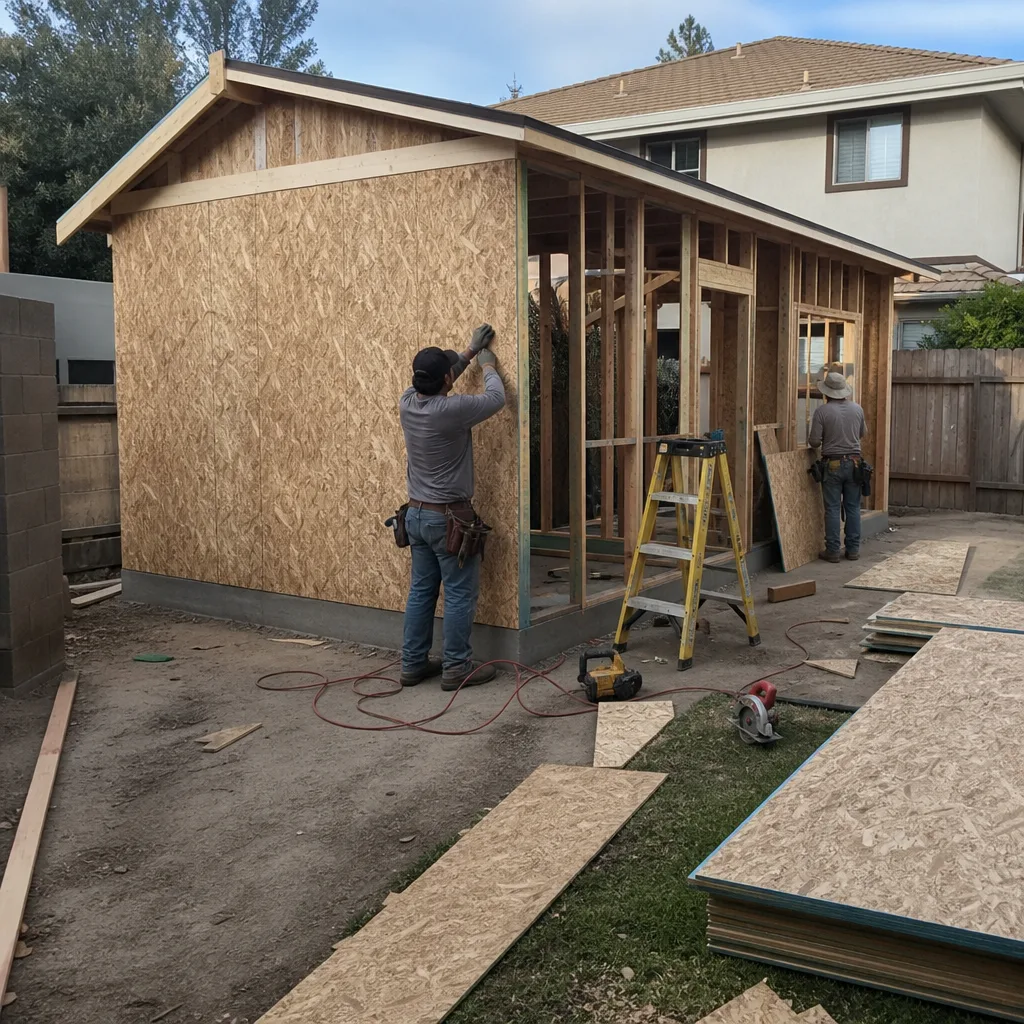
A custom ADU in Highland gives you complete control over dimensions, roofline, and finishes, and is the right choice for homeowners who need a specific design, have unusual lot geometry, or want the ADU to match the primary residence in architectural character. The tradeoff is time: stick-built in Highland typically runs 10 to 14 months from permit to certificate of occupancy, compared to 6 to 10 for panelized systems and 4 to 8 for volumetric modular units that arrive finished.
We work across all these methods at Sunburst ADU Builders home because the right answer depends on your specific parcel, not on which brand a builder carries. A homeowner with a flat 10,000-square-foot lot and fast timeline goals will honestly be better served by a Boxabl unit than by a custom build that spends six months in framing. A homeowner with a steep East Highlands Ranch lot and an HOA architectural review will need something closer to a Plant Prefab panel system or a custom design. The method should follow the site, not the other way around.
We also specify James Hardie fiber-cement siding on any ADU where exterior durability matters, which in the Inland Empire means essentially every project. The high-desert sun fades vinyl and the occasional wind event tests every fastener; Hardie’s warranty-backed material is designed for exactly this climate. If you are finishing an ADU that includes a kitchen or bathroom, the connection between our ADU Builders in Highland work and our Kitchen Remodeling in Highland scope means the unit is completed under one contract rather than stitched together across three different crews.
Common Mistakes to Avoid
- Assuming your address falls under City of Highland rules because the mail says Highland. Verify jurisdiction before you spend a dollar on design. Unincorporated county properties follow a different review path with different fees and different septic requirements.
- Ignoring the utility capacity question until after permit submittal. A meter upsizing or sewer lateral repair discovered late in the process is the most common cause of unexpected four-figure costs and multi-week delays on Highland ADUs.
- Copying an LA-area ADU plan for a sloped Highland lot. Flat-lot foundations assume a level pad. A stepped foundation or pier system requires different engineering, and trying to force a standard plan onto grade adds cost and review time.
- Underwriting your rental ADU at 100% occupancy. The Inland Empire market is strong, but it follows the logistics employment cycle. Budget for realistic vacancy, and the deal will stay comfortable through the slow months.
- Choosing a build method before evaluating your site. A modular unit that requires a crane might not fit a hillside street, and a stick-built project might be needlessly slow on an open flat lot. Match method to parcel first.
- Forgetting the school fee assessment in your budget. ADU permits in Highland area jurisdictions carry impact fees that are not discretionary. Factor them into your total project cost from day one rather than treating them as a closing surprise.
- Assuming your HOA cannot restrict ADUs. State law overrides private covenants in many cases, but an HOA can still control architectural style, exterior materials, and placement. Bring the HOA into the conversation early, especially in East Highlands Ranch.
When to Call a Professional
Most Highland homeowners do not need a general contractor on day one, but there are several points where professional input changes the trajectory of the project. If your lot has more than 3 feet of grade change, you should bring in an ADU specialist before you finalize any design assumptions, because foundation strategy drives everything downstream. If your property is on septic, if your water meter is smaller than 1 inch, or if you have any uncertainty about jurisdiction, a local professional with Highland-specific experience can resolve those questions in a single consultation that would otherwise take you weeks of calls to different agencies. And if you are comparing different build methods, an expert who works across prefab and modular platforms can give you honest side-by-side numbers rather than a single-brand pitch. Sunburst ADU Builders offers free estimates in Highland. Call (855) 676-6807 and we will walk your lot, check your utilities, and give you a straight comparison of what actually works for your parcel.
Frequently Asked Questions
A detached ADU in Highland typically costs between $180,000 and $420,000 all-in, with prefab and modular units landing in the $180,000 to $300,000 range and custom stick-built ADUs running $250,000 to $420,000. Site conditions like slope and septic requirements move the number more than any other single factor. Call (855) 676-6807 for a free estimate based on your specific lot.
From design start to certificate of occupancy, most Highland ADUs take 8 to 14 months. Permitting in the City of Highland runs 3 to 4 months for complete submittals, and construction adds 4 to 10 months depending on build method and site conditions.
Yes, state law guarantees the right to rent an ADU regardless of local restrictions, and the Inland Empire rental market supports $1,600 to $2,500 monthly for new one-to-two-bedroom units in Highland. You cannot rent the ADU as a short-term vacation rental under 30 days in most cases, but long-term rental is fully permitted.
California law voids HOA covenants that outright prohibit ADUs, but an HOA can still regulate exterior appearance, setback compliance beyond state minimums, and landscaping. East Highlands Ranch HOAs in particular have active architectural review committees, so submit your plans to the HOA early in the process.
Generally yes, a prefab or volumetric modular ADU in Highland runs 20 to 30 percent less than a custom stick-built unit of the same size, and it can be completed 3 to 6 months faster. The tradeoff is design flexibility: prefab units come in standardized dimensions and finish packages, while custom builds can match any architectural style.
State law allows a detached ADU of up to 1,200 square feet on a single-family lot, subject to local setback and lot coverage rules. Your specific allowable size in Highland depends on your lot’s total square footage, the footprint of your existing home, and jurisdictional requirements from either the city or the county.
The Bottom Line
An ADU in Highland is one of the strongest long-term value plays in Southern California right now, and the reason is structural rather than speculative: large lots, lower land costs, and a rental market that has not yet priced in the region’s employment growth. The key is treating Highland as its own market rather than importing LA assumptions. Verify your jurisdiction, check your utility capacity before you design, match your build method to your actual terrain, and underwrite at realistic occupancy. If you want someone who has done this on Highland parcels from the flats to the foothills, we are here. We work with Bathroom Remodeling in Highland and kitchen finishing to make sure your unit is truly turnkey, not just structurally complete. Call (855) 676-6807 to schedule a free estimate, and we will give you an honest comparison of what works on your specific lot.
Written by the team at Sunburst ADU Builders, serving Highland since 2018.